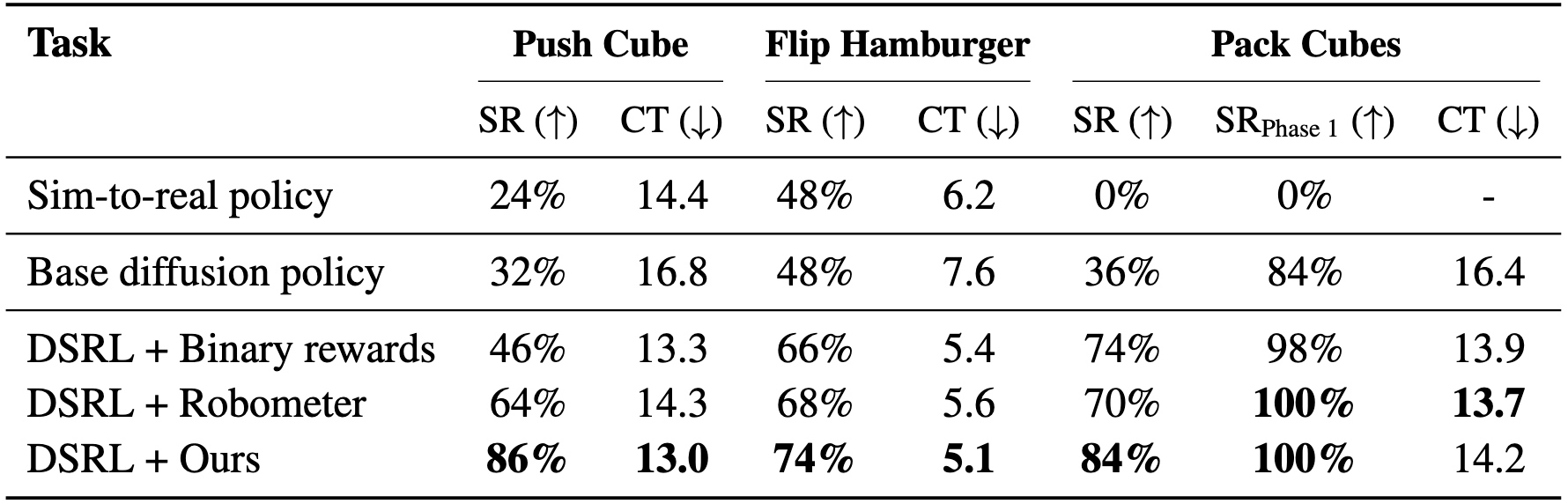
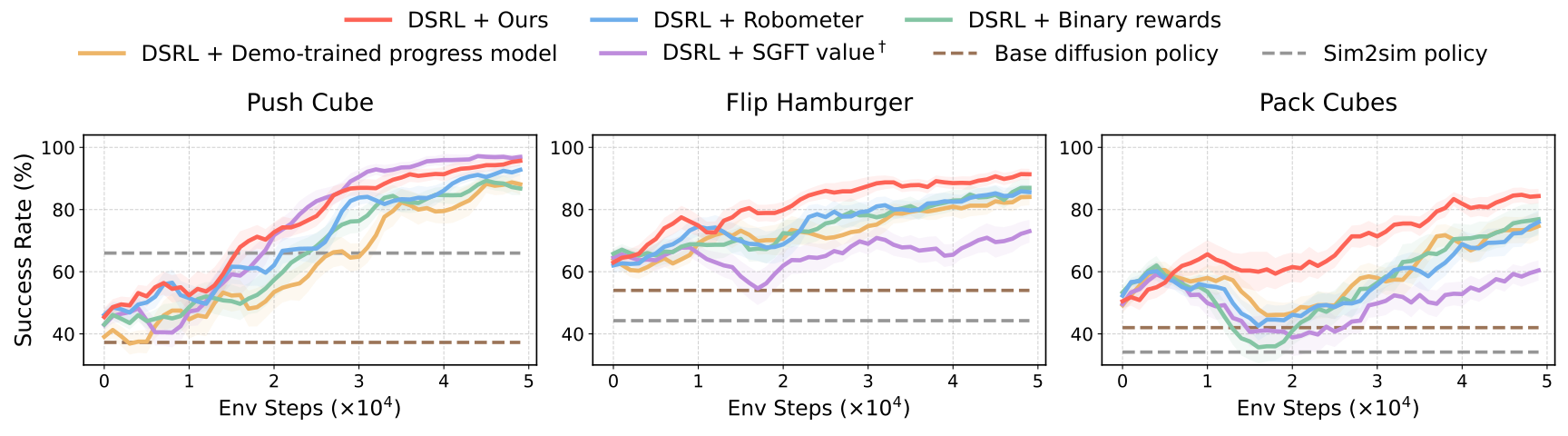
Real-world reinforcement learning (RL) is a promising approach for advancing robotic manipulation, but how to obtain informative and robust reward signals remains a central challenge. Recent works have explored reward models trained on real robotic data to enable efficient real-world RL. However, this formulation can be expensive and infeasible due to the high-dimensional state space and its dependence on real-world expert data. In this paper, we address this limitation with Value Sim-to-Real (VSR), a novel framework that leverages simulation-trained value functions to define informative, high-quality reward functions for efficient real-world RL. We evaluate our method with both sim-to-sim and sim-to-real experiments on several vision-based contact-rich tasks. We show that VSR learns a smooth value function that strongly correlates with task progress and improves the performance and sample efficiency of downstream RL with its induced reward function.
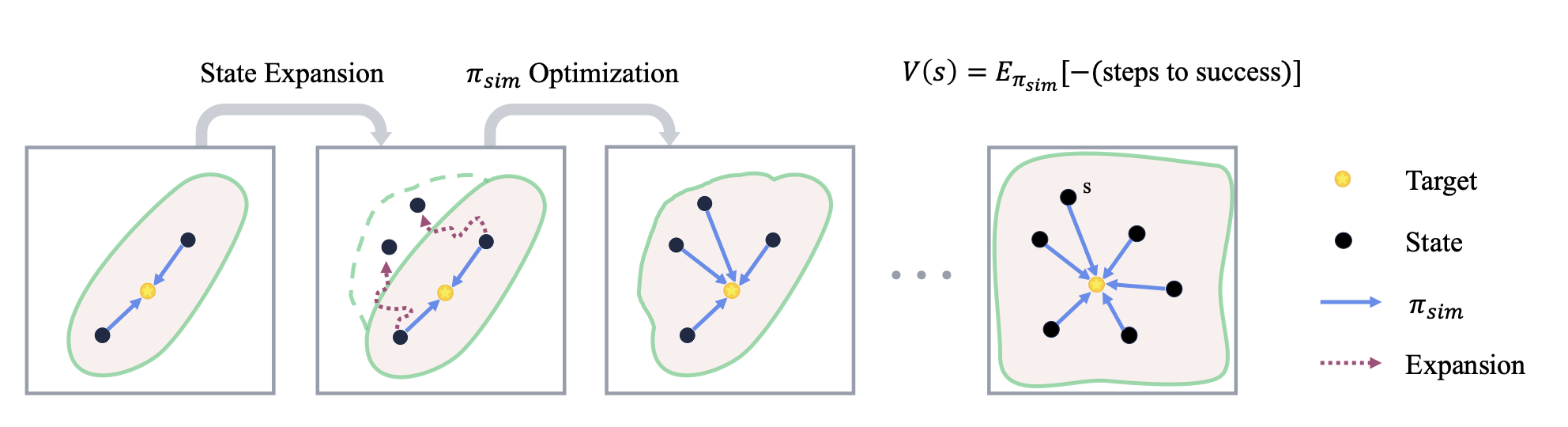
VSR alternates state expansion and policy optimization in simulation to build a diverse buffer \(\mathcal{B}\) of task-relevant states and train a policy \(\pi_{\mathrm{sim}}\) that efficiently completes the task from these states.
We generate a dataset by rolling out \(\pi_{\mathrm{sim}}\) from states in \(\mathcal{B}\), labeling each state with the negative number of steps to success as an approximation to its optimal value \(V^*(s)\).
These value estimates are then distilled into a visual state-value function on segmented point clouds for sim-to-real transfer.